.png)


From Little Hands to Meaningful Words - How Writing Really Begins
How Writing Really Begins
A walk through a preschool can reveal a lot about how children grow.
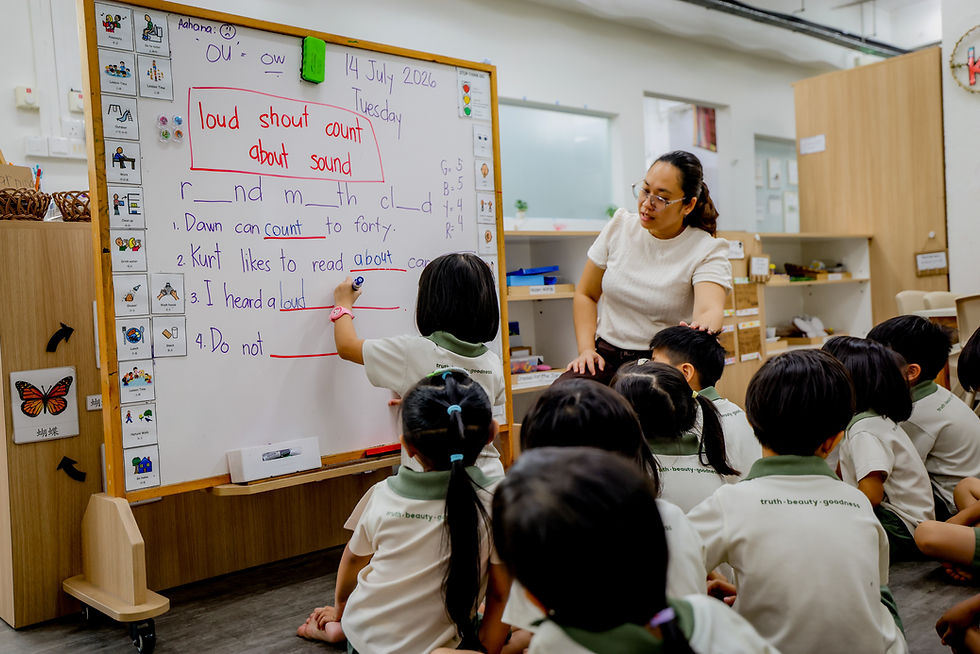
Step into a K2 classroom and you might see children carefully forming letters, writing sentences or completing literacy activities. The familiar rhythm of pencil on paper is often what parents associate with learning to write.
Step into one of our younger classrooms and the picture looks very different.
Instead of worksheets, little hands are busy threading beads, building with blocks, manipulating loose parts, squeezing playdough and sorting objects.
At first glance, these activities may seem unrelated to writing.
In reality, they are where writing begins.
Before writing comes hands that are ready
When a child struggles to control a pencil, it is not always because they need to "try harder." More often, it is because their hands are still developing the strength and coordination needed for writing.
Writing is a surprisingly complex skill. It requires children to coordinate their eyes and hands, develop strength in the small muscles of their fingers, stabilise their wrists and use both hands together with control.
These abilities cannot be rushed.
That is why purposeful play is such an important part of the early years.
When children work with peg boards, threading activities, tongs, puzzles, construction materials or playdough, they are doing far more than keeping themselves occupied.
They are strengthening the foundations that will eventually allow them to hold a pencil confidently and write with ease.
Every squeeze, twist, stack and thread is preparing their hands for what comes next.

But writing is more than holding a pencil
Strong hands alone do not make confident writers.
Even when children have developed the physical skills to write, writing can still feel like a task if it is simply about forming letters correctly or completing another page of practice.
Children are naturally motivated when they understand why writing matters.
Writing becomes meaningful when it helps them communicate something important.
A thank you card for a friend.
A birthday message for a parent.
A shopping list during pretend play.
A label for a drawing they are proud of.
A story inspired by their imagination.
In these moments, children discover that writing is not simply an activity to complete.
It is a way to share ideas, express feelings and connect with other people.
At Little Olive Tree, we nurture both
At Little Olive Tree, we believe children need both the foundations and the purpose for writing.
We intentionally create opportunities for children to strengthen the physical skills that writing requires through purposeful, hands on experiences that are developmentally appropriate.
At the same time, we provide meaningful opportunities for children to communicate, whether through conversations, storytelling, dramatic play, drawing or writing.
Because communication begins long before children can write.
Over time, children discover that their ideas matter.
Their stories matter.
Their voices matter.
Writing simply becomes another way to express what has been growing within them all along.
A gentle encouragement for parents
It is natural for parents to wonder whether their child is "on track."
But every child develops at their own pace.
If your child is still strengthening their hands through play, they are not falling behind. They are preparing for what comes next.
If your child loves telling stories, asking questions and expressing ideas through conversation, they are already developing important foundations for writing.
These experiences are not separate from learning to write.
They are part of the journey.
When children are physically ready and understand that writing has meaning, they approach it with greater confidence and purpose.
Every child has something worth saying
The pencil and paper stage is an important milestone, but it is not where the journey begins.
It begins with curious minds, capable hands and children discovering that their thoughts, ideas and experiences are worth sharing.
Because the ultimate goal is not simply to raise children with neat handwriting.
It is to nurture children who use writing to communicate, connect and make a meaningful contribution to the world around them.

Join Us at Our Open House
Every child learns and grows in their own unique way, and we'd love to show you how we support that journey at Little Olive Tree.
Join us at our Open House to meet our educators, explore our thoughtfully designed learning environments and discover how purposeful play, meaningful experiences and caring relationships lay the foundations for confident learners and communicators.
We look forward to welcoming you and your family.


