.png)


Beyond the Classroom: What Our Visitors Saw in Little Olive Tree’s Approach to Chinese Language Learning
Updated: Aug 24

At Little Olive Tree, meaningful learning begins with seeing, listening and responding to children. A recent visit by Chinese language and early childhood education specialists gave us an opportunity to reflect on how these principles come alive in our classrooms.
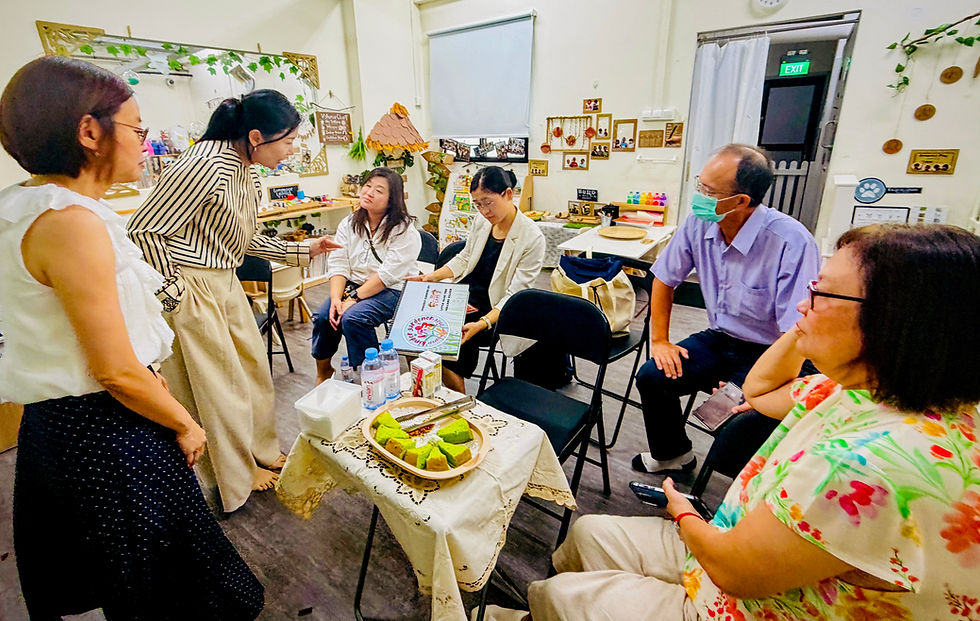
On 14 August 2026, just one day before the Singapore Chinese Language Seminar 2026, Little Olive Tree Holland Village had the privilege of welcoming a distinguished group of Chinese language and early childhood education professionals to our Holland Village campus.
Our guests included invited keynote speaker Professor Pan Shih Tsun from Taiwan, Associate Professor Zhang Li from China, Dr Lin Meilian, former NTUC Curriculum Director and current Head of the Mother Tongue Learning Committee, and Dr Wan Lijing, a veteran early childhood educator.
The visit provided an opportunity for our guests to observe classroom experiences, engage with our educators and gain a closer understanding of how learning takes place at Little Olive Tree.
More importantly, it gave us an opportunity to reflect on something at the heart of our educational approach:
"What happens when teachers truly observe, listen and respond to children?"
Seeing Children as Active Participants
During the visit, the guests observed a Playgroup classroom where the quality of teacher and child interactions stood out.
At this young age, children do not always communicate through words. They express themselves through movement, sounds, gestures, music and many other forms.
The teacher created opportunities for children to participate through these different forms of expression.
During a birthday song segment, for example, the teacher incorporated musical instruments and sang together with the children. The experience allowed the children to participate actively rather than simply watch or listen.
At the same time, the teacher remained attentive to every child in the classroom, observing their actions and responding promptly to their individual needs and cues.
"These moments may appear simple, but they are significant."

For young children, learning happens through relationships. When a teacher notices a child’s response, listens to what the child is communicating and responds meaningfully, the child learns that their ideas, actions and presence matter.
When Questions Become Invitations to Think
In a K2 grammar story lesson conducted by Teacher Hong, the visitors observed another important aspect of Little Olive Tree’s approach: the use of questions to encourage children to think.
Rather than simply presenting the correct answer, the teacher used open ended questions to invite the children to share their ideas and participate in a collaborative discussion.
Professor Pan Shih Tsun particularly commended the teacher’s approach to teacher and child interaction and questioning.
During his observation, he noted how the teacher responded flexibly to the children’s immediate responses, adapting and extending her questions according to what the children contributed.
The questions were also well sequenced and interconnected, progressively guiding the children in their thinking, responses and expression.
This is an important distinction in language learning. The goal is not simply for children to remember vocabulary, grammar rules or produce the right answer. It is also about helping children develop the confidence to express an idea, listen to another perspective, respond thoughtfully and gradually develop their own understanding.
In this classroom, the teacher and children were not simply working through a lesson.
"They were thinking together."
Learning Through Observation, Exploration and Choice
The visitors also observed Teacher Anne’s construction lesson, where children were given shapes as a starting point and invited to create their own airplane designs using construction blocks.

While every child worked with the structural elements introduced by the teacher, each airplane was different.
And that difference was meaningful.
The activity demonstrated principles of Universal Design for Learning, or UDL, by allowing children to use their own observations and approaches while working towards a shared learning experience.
There was no expectation that every child would produce an identical model.
Instead, children were given an opportunity to observe, interpret, make decisions and carry out the task in their own way.
This reflects an important belief about learning:
"A common learning goal does not always require a common outcome."
Children can demonstrate their understanding differently, and those differences can be an important part of the learning process.
What This Means for Chinese Language Learning
Although the classroom experiences observed during the visit were varied, they shared a common thread.

The children were not passive recipients of information.
They were encouraged to participate actively, express themselves in different ways, listen and respond, ask and answer questions, make connections, think through problems and contribute to a shared learning experience.
For us at Little Olive Tree, this is particularly meaningful when it comes to Chinese language education.
Language learning in the early years is much more than learning vocabulary, sentence structures or grammar.
"Language is something children experience and use."
It can happen through a story, a song, a conversation, a question, a movement, a dramatic experience or a shared discovery.
A child may use language to tell a story, explain an idea, respond to a teacher, negotiate with a friend or simply express how they feel.
These meaningful interactions give children reasons to communicate.
And this requires teachers who do more than deliver a lesson.
It requires teachers who observe closely, listen carefully and respond thoughtfully.
Recognition That Belongs to the Whole Team
During the visit, Dr Lin Meilian, who currently serves as Head of the Mother Tongue Learning Committee, gave positive recognition to Little Olive Tree’s Chinese language curriculum.
For our team, this was a meaningful affirmation of the work we do.
But recognition of a curriculum is never the work of one person.
Behind every lesson are educators who plan, discuss, observe, reflect and refine their practice. Behind every classroom interaction are teachers who make countless decisions in response to the children in front of them.

The positive feedback from our visitors is therefore also a reflection of the dedication and collective efforts of our Curriculum Department and teachers.
We are grateful for their commitment to continually creating meaningful learning experiences for our children.
Learning Through Professional Exchange
"Visits like this remind us that education is never static."
There is always something new to learn, something to reflect on and another perspective that can challenge us to think more deeply about our practice.
Opening our classrooms to experienced educators and academics also creates opportunities for genuine professional dialogue.
We share what we do.
We listen to what others observe.
And we return to our classrooms with new questions.
How can we listen more closely to children?
How can we create more opportunities for every child to participate?
How can our questions help children think more deeply?
How can we design learning experiences that allow children to express their understanding in different ways?
"These questions are not answered once and for all.
They are part of the ongoing work of teaching."
Looking Beyond the Lesson
Perhaps the most meaningful takeaway from the visit is that good teaching is not always about how much a teacher can tell a child.
Sometimes, it is about how well a teacher can listen.
It is about noticing the child’s response.
It is about asking another question instead of giving an answer.
It is about allowing a child to find their own way of completing a task.
It is about recognising that every child brings a different perspective and a different way of expressing what they know.
At Little Olive Tree, we believe these moments are at the heart of meaningful early childhood education.

Because ultimately, we are not only teaching children what to learn.
"We are creating opportunities for children to think, communicate, participate and grow."
And as educators, we will continue to learn alongside them.
Continuing the Journey Together
We are grateful to Professor Pan Shih Tsun, Associate Professor Zhang Li, Dr Lin Meilian and Dr Wan Lijing for taking the time to visit Little Olive Tree@HLV, observe our classrooms and engage in professional exchange with our educators.
We are equally grateful to our Curriculum Department and teachers, whose dedication and thoughtful work make these learning experiences possible every day.
For us, professional recognition is not the destination.
It is encouragement to keep learning, keep reflecting and keep doing better for our children.
"Because when we listen to children, we discover more about how they learn. And when we continue learning as educators, we create better possibilities for them to grow."

FAQ
What did the visiting educators observe at Little Olive Tree@HLV?
The visitors observed several classroom experiences, including a Playgroup class, a K2 Chinese language lesson and a construction activity. Their observations focused on teacher and child interactions, children’s participation, questioning, language learning and opportunities for children to express themselves in different ways.
What stood out about Little Olive Tree’s approach to Chinese language learning?
The visitors observed that children were actively involved in the learning process. Teachers listened to children’s responses, used open ended questions and adapted their teaching according to the children’s ideas and responses.
Why are open ended questions important for young children?
Open ended questions give children opportunities to think, express their ideas and develop their language. When teachers listen to children’s responses and extend the conversation, children are encouraged to think more deeply and communicate their ideas with greater confidence.
What does teacher and child interaction look like at Little Olive Tree?
Meaningful teacher and child interaction goes beyond giving instructions. Teachers observe children’s cues, listen to their responses and respond to their actions, interests and needs. This helps children feel seen, heard and actively involved in their learning.
What is Universal Design for Learning?
Universal Design for Learning is an approach that recognises that children may learn and express their understanding in different ways. In the construction activity observed at Little Olive Tree@HLV, children worked from a common starting point but created their own individual airplane designs.
Does every child need to produce the same outcome?
Not necessarily. Children can work towards a shared learning goal while demonstrating their understanding in different ways. Providing opportunities for individual expression allows children to draw on their own observations, ideas and strengths.
Why is feedback from visiting educators important?
External professional perspectives give educators opportunities to reflect on their practice and learn through dialogue. The positive observations shared during the visit were a meaningful affirmation of Little Olive Tree’s approach, while also encouraging us to continue reflecting and growing.
How does this connect to Little Olive Tree’s educational philosophy?
At Little Olive Tree, we believe children learn through meaningful relationships and experiences. We seek to create environments where children can participate, explore, communicate, think and express themselves, while teachers observe closely, listen carefully and guide their learning.


